

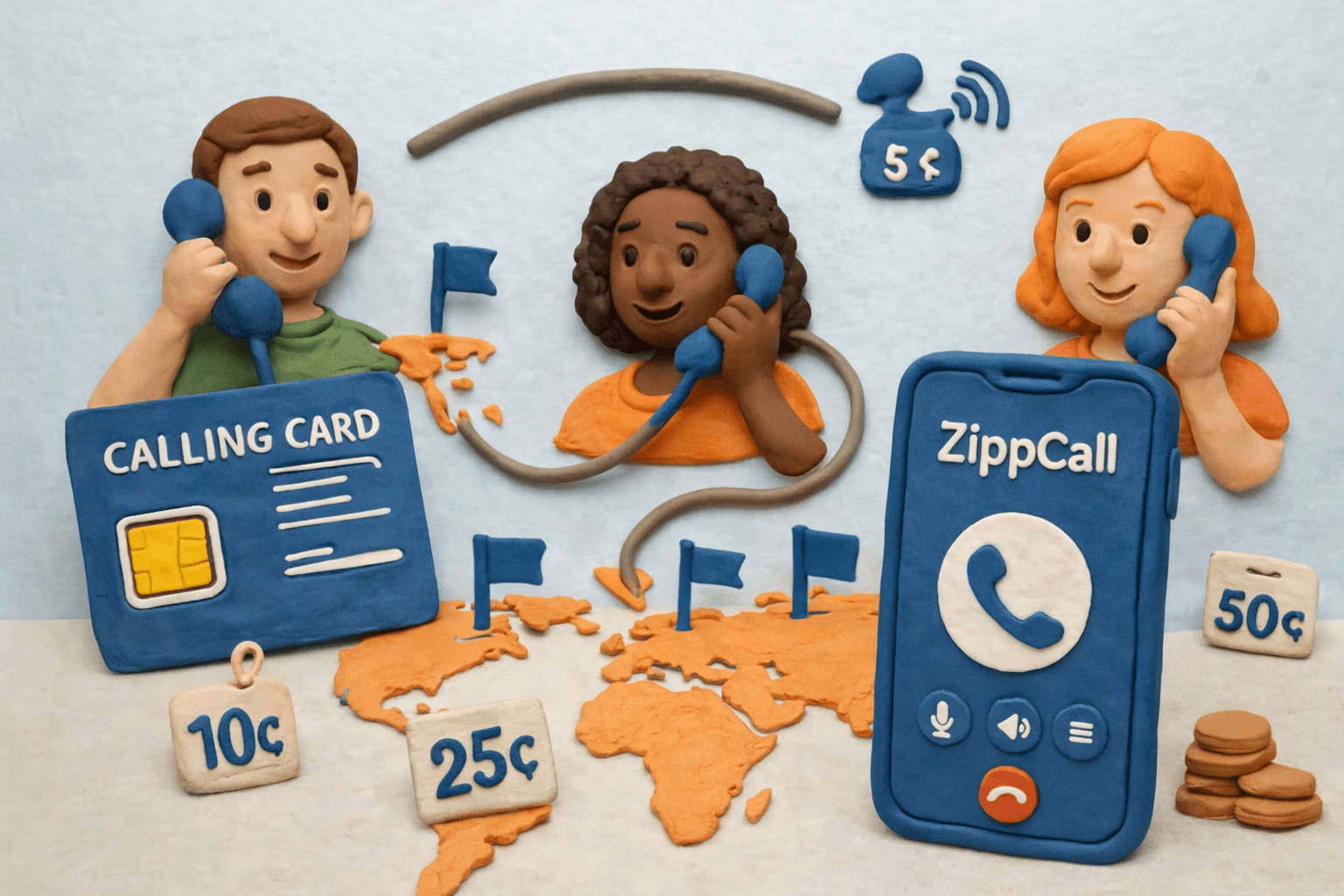
In 2026, it’s easy to assume international calling cards are a relic from another era. Between WhatsApp, FaceTime, Wi-Fi calling, and mobile plans that promise international minutes, the idea of buying credit just to make a phone call can feel outdated.
But international calling cards haven’t disappeared — and usually for practical reasons, not nostalgia. People still need to call landlines, customer support numbers, banks, government offices, and family members who don’t use smartphones. Others rely on them when travelling, dealing with unreliable internet connections, or trying to keep costs predictable without committing to a phone plan.
Part of the confusion is that the meaning of “calling card” has changed. What once meant a physical card with a scratch-off PIN now often refers to digital credit, app-based calling, or web-based services. The name stayed the same, but the experience didn’t — which makes it harder to tell what’s still relevant and what isn’t.
This guide is designed to clear that up. It explains what international calling cards look like today, why people still use them, where they fall short, and how they fit alongside modern alternatives — so you can decide what actually makes sense for your situation.
TL;DR
- International calling cards still exist in 2026 because they solve specific problems — especially calling landlines, banks, and people without smartphones.
- They work by using prepaid credit to route international calls separately from your normal phone plan.
- People still use them when internet access is unreliable, costs need to be controlled, or apps aren’t an option.
- Downsides include hidden fees, credit expiry, clunky access methods, and inconsistent call quality depending on the provider.
- For smartphone-to-smartphone calls with good data, modern apps are usually simpler.
- Hybrid, pay-as-you-go services like ZippCall combine elements of calling cards with modern app or web access, without subscriptions.
- The best option depends on who you’re calling, how often, and under what constraints — not just headline rates.
What are international calling cards?
International calling cards are a way to make phone calls to other countries using prepaid credit, rather than being billed through your normal mobile or landline provider.
In simple terms, you buy credit in advance and use that credit to place international calls. The cost of each call is deducted from your balance based on the destination and length of the call. When the credit runs out, you top up again if you want to keep using the service.
One reason calling cards can feel confusing is that they no longer always look like cards. While physical cards still exist, many modern services now offer digital credit instead. That credit might be used through a mobile app, a website, or by dialling an access number from a regular phone. The underlying idea is the same, even if the delivery has changed.
Another important point is that calling cards sit alongside your phone plan, rather than replacing it. They don’t replace your SIM, mobile contract, or landline. Your phone is simply the device you use to place the call, while the calling card service handles the international routing and billing.
In short, an international calling card isn’t a specific product or format. It’s a prepaid way of routing international calls, which can be delivered through physical cards, apps, websites, or access numbers depending on the provider.
How international calling cards work (step by step)
Although the formats have changed over the years, the basic flow of an international calling card is still fairly simple. What matters is understanding how a call is routed and how credit is used, regardless of whether you’re using a physical card, an app, or a website.
Here’s the typical process:
You buy credit in advance
Instead of being billed after the call, you purchase a set amount of credit upfront. This might be £5, £10, or another fixed amount, depending on the service. That credit is stored on your account or card and used only for international calls.
You place the call using an access method
- How you start the call depends on the type of calling card:
- Dialling a local or international access number from your phone
- Using a mobile app that connects the call for you
- Calling directly from a website or browser
In all cases, your phone is just the starting point. The international part of the call is handled by the calling card provider, not your mobile network.
The call is routed through the provider’s network
Once the call connects, it’s routed through the provider’s international network rather than your normal carrier’s international rates. This is what allows calling cards to offer different pricing and coverage from standard phone plans.
Credit is deducted as the call runs
- Your balance decreases based on:
- the destination country
- whether you’re calling a landline or mobile
- how long the call lasts
Some services deduct credit per second, others round up to the nearest minute or more. The exact rules depend on the provider, which is why understanding the fine print matters.
The call ends when you hang up or credit runs out
When the call finishes, the remaining balance stays on your account until you use it again, top up, or — in some cases — it expires.
A useful way to think about it
A calling card doesn’t change who you’re calling — it changes how the international part of the call is paid for and routed. Your phone still makes the call, but the calling card service sits in the middle, handling the international connection and billing separately from your normal phone plan.
Why people still use international calling cards
On paper, international calling cards can look unnecessary. Messaging apps are free, video calls are everywhere, and many mobile plans advertise international minutes. But in practice, those options don’t cover every situation — which is why calling cards are still in use.
One common reason is landlines. Many banks, government offices, utilities, and customer support services still rely on traditional phone numbers. Despite assumptions that landlines have disappeared, a significant proportion of households continue to use them — particularly older people and those outside major cities, according to recent survey data from YouGov.
Another factor is who you’re calling. Not everyone uses a smartphone, and not everyone is comfortable installing apps or managing updates. Older relatives, people in rural areas, or households that rely on a shared landline often fall into this category. Calling cards work without asking the other person to change how they communicate.
Internet reliability also plays a role. App-based calling assumes a stable data connection on both ends. In reality, people travel, work abroad, or live in places where mobile data is slow, expensive, or inconsistent. In those situations, a regular phone call routed through a calling card can be more reliable than a voice-over-internet app.
There’s also the issue of cost control. Calling cards are prepaid, which means spending is capped upfront. For some people, that predictability matters more than headline per-minute rates. It’s easier to budget when you know the maximum you can spend, especially when calling internationally from unfamiliar networks.
Finally, familiarity shouldn’t be underestimated. Many people started using calling cards years ago and never had a strong reason to stop. If something works, feels understandable, and doesn’t create surprises on a phone bill, there’s little pressure to replace it — even if newer options exist.
None of this means calling cards are the best solution for everyone. It does explain why they haven’t disappeared, and why they still solve specific problems that modern apps don’t always address well.
Downsides and limitations to be aware of
International calling cards can be useful, but they aren’t friction-free. Much of the frustration people experience comes from how calling cards are sold, rather than how they work. That’s why it’s worth being clear about the common limitations before deciding whether they make sense for you.
One issue is fees that aren’t obvious upfront. Some calling cards advertise very low per-minute rates, but apply additional charges when you place a call. These can include connection fees, minimum call lengths, or rounding rules that bill calls in fixed increments rather than by the second. For short or occasional calls, these details can matter more than the headline rate.
Another common limitation is credit expiry. Many calling cards require you to use your balance within a set time period. If the card isn’t used regularly, unused credit may expire or be reduced by maintenance fees. This often catches infrequent callers off guard, especially if they assume prepaid credit will remain available indefinitely.
Access methods can also feel clunky, particularly with more traditional cards. Dialling access numbers, entering PINs, and navigating automated menus adds friction compared to tapping a contact in an app. While newer services reduce this complexity, not all calling cards offer the same level of convenience.
Call quality is another variable. Because calling cards route calls through third-party networks, quality can depend on factors outside your control, including the destination country, time of day, and the provider’s routing arrangements. Some services are reliable, others less so — and it’s not always easy to know which is which in advance.
Finally, customer support can be inconsistent. Calling cards are often sold at low margins, and support isn’t always a priority. If something goes wrong — missing credit, dropped calls, or unclear charges — resolving the issue can take longer than expected, particularly with older or reseller-based services.
None of these drawbacks mean calling cards are unusable. They do mean they work best when you understand the rules before you start, rather than discovering them after credit has already been spent.
Are international calling cards still worth using in 2026?
Whether an international calling card makes sense in 2026 depends less on the year and more on the situation you’re in. For some people, they still solve a real problem. For others, they add unnecessary complexity.
Calling cards tend to make sense when traditional phone calls are unavoidable. If you regularly need to call landlines, customer support numbers, banks, or government offices abroad, messaging apps simply aren’t an alternative. In those cases, a calling card can be a predictable — and sometimes cheaper — way to place those calls, especially if your mobile provider’s international rates are unclear or expensive.
They can also work well when internet access is unreliable or limited. App-based calling assumes both you and the person you’re calling have a stable data connection. When that isn’t the case — whether due to travel, location, or cost — a standard phone call routed through a calling card can be more dependable.
For people who value spending control, prepaid credit can be a feature rather than a drawback. Knowing exactly how much you can spend upfront can be reassuring, particularly if you’re calling internationally from unfamiliar networks or helping someone else manage costs.
On the other hand, calling cards are often a poor fit if your communication is mostly smartphone-to-smartphone. If the people you call are already comfortable using apps and you have reliable internet access, app-based calling is usually simpler and more convenient. In those situations, calling cards can feel like an extra layer you don’t really need.
They can also be frustrating for infrequent callers. Expiry rules, maintenance fees, or forgotten balances can outweigh any savings if you only make the occasional international call. Without regular use, the disadvantages become more noticeable.
So rather than asking whether calling cards are “still worth it” in general, it’s more useful to ask a narrower question: what problem are you actually trying to solve? If that problem involves landlines, limited internet, or strict cost control, calling cards can still make sense. If it doesn’t, newer alternatives may be easier.
Modern alternatives to international calling cards
International calling cards aren’t the only way to make international calls anymore, and for many people they’re no longer the default option. Over the past decade, several alternatives have become common — each with their own trade-offs.
One broad category is app-based calling services. These use an internet connection to place calls through a mobile app. They’re often quick to set up and work well when both you and the person you’re calling have reliable data access. However, they can fall down when calling landlines, customer service numbers, or people who don’t use smartphones.
Another option is web-based calling, where calls are placed directly from a browser rather than a phone app. This can be useful if you’re working from a laptop or don’t want to install anything, but it still depends on having a stable internet connection and doesn’t always solve the landline problem.
There are also hybrid services that sit somewhere between traditional calling cards and modern apps. These tend to combine prepaid credit with app or web access, aiming to reduce the friction of access numbers and PINs while keeping costs predictable. In practice, how well this works depends on the provider and the specific use case.
Finally, some people rely on international add-ons from mobile carriers. These can be convenient, but pricing and coverage are often inconsistent, and the cost can be hard to predict unless you read the terms closely.
None of these options fully replaces international calling cards in every situation. They reflect the fact that international calling is no longer a single problem with a single solution — and that choosing the right approach depends on who you’re calling, how often, and under what constraints.
How to choose the right option for your situation
Rather than starting with providers or prices, it’s usually easier to work backwards from your situation. A few simple questions can help narrow down what actually makes sense.
Who are you calling?
If you mostly call landlines, businesses, banks, or government offices, you’ll need a solution that supports regular phone calls. Messaging apps won’t help in those cases. If you’re calling friends or family who already use smartphones, app-based calling may be enough.
How reliable is your internet connection?
If you have stable, affordable data most of the time, app or web-based calling can be convenient. If your internet access is unreliable, expensive, or inconsistent, traditional phone calls — including those routed through calling cards — are often more dependable.
How often do you call internationally?
For frequent callers, ease of use and consistency usually matter more than small per-minute savings. For occasional callers, prepaid options can help avoid long-term commitments — but only if credit doesn’t expire before you use it.
Do you need predictable spending?
If controlling costs is important, prepaid credit can be reassuring. You know the maximum you can spend upfront, which can be helpful when calling internationally from unfamiliar networks or when managing someone else’s usage.
How comfortable are you with setup and menus?
Some options prioritise simplicity, while others trade convenience for flexibility or lower headline rates. If dialling access numbers, entering PINs, or navigating menus feels frustrating, newer app-based or hybrid options may be a better fit.
There isn’t a single “right” choice that works for everyone. The best option is usually the one that removes the most friction from your specific calling needs, rather than the one with the lowest advertised rate.
Frequently asked questions about international calling cards
Are international calling cards cheaper than mobile international rates?
They often can be, but it depends on how your mobile provider prices international calls. Many mobile plans still charge high per-minute rates for calling abroad, especially to landlines or outside bundled destinations. Calling cards route calls differently and can offer more predictable pricing — as long as you understand any fees or expiry rules.
Do international calling cards still work from mobile phones?
Yes. Most modern calling cards can be used from mobile phones in a few different ways, including mobile apps, browser-based calling, or by dialling access numbers. You don’t usually need a special phone — just a way to place a call or access the service.
Can I use a calling card to call landlines?
Yes, and this is one of the main reasons people still use them. Calling cards typically support landlines as well as mobile numbers, which makes them useful for calling banks, offices, and people who don’t use smartphones.
Do international calling cards require internet access?
Not always. Some calling cards rely on apps or web calling and need an internet connection. Others work by dialling access numbers from a regular phone line, which doesn’t require mobile data or Wi-Fi. The exact requirement depends on how the service is set up.
Do calling card balances expire?
Sometimes. Some calling cards require you to use your credit within a certain time period, while others deduct maintenance fees after inactivity. A smaller number allow credit to remain indefinitely. This is one of the most important terms to check before buying.
Are international calling cards safe to use?
Reputable calling card providers are generally safe, but quality and transparency vary. It’s worth checking that the provider clearly explains pricing, fees, and expiry rules, and offers a way to view your balance and call history.
Can I use an international calling card from abroad?
In most cases, yes. Calling cards are often used while travelling or living abroad, as long as you can access the service through a phone, app, or internet connection. Some access numbers may vary by country, so it’s worth checking coverage before relying on one.
Are calling cards better than calling apps?
Neither is universally better. Calling cards tend to work well for landlines, limited internet access, and cost control. Calling apps are usually easier for smartphone-to-smartphone calls when both sides have reliable data. The better option depends on what you need to do.
International calling cards still have a place in 2026, but mainly in specific situations. They can make sense when you need to call landlines, banks, government offices, or people who don’t use smartphones, or when internet access is unreliable and spending control matters. For app-to-app calling with good data, modern alternatives are usually simpler. The key is understanding the trade-offs — fees, expiry rules, access methods — and choosing the option that fits how and who you actually need to call. For people who still need real phone calls without subscriptions, modern pay-as-you-go services like ZippCall sit somewhere between traditional calling cards and newer app-based options.
Disclosure: ZippCall is an international calling service built around prepaid, pay-as-you-go credit rather than monthly plans. It’s mentioned here for transparency, not as a default recommendation.

Entrepreneur and founder of ZippCall. After years living abroad, Josh built ZippCall to make international calling simple, affordable, and reliable.
Ready to Try ZippCall?
Make affordable international calls on web, iPhone, and Android devices. Crystal-clear quality with competitive rates.
1 minute setup. No subscription required.